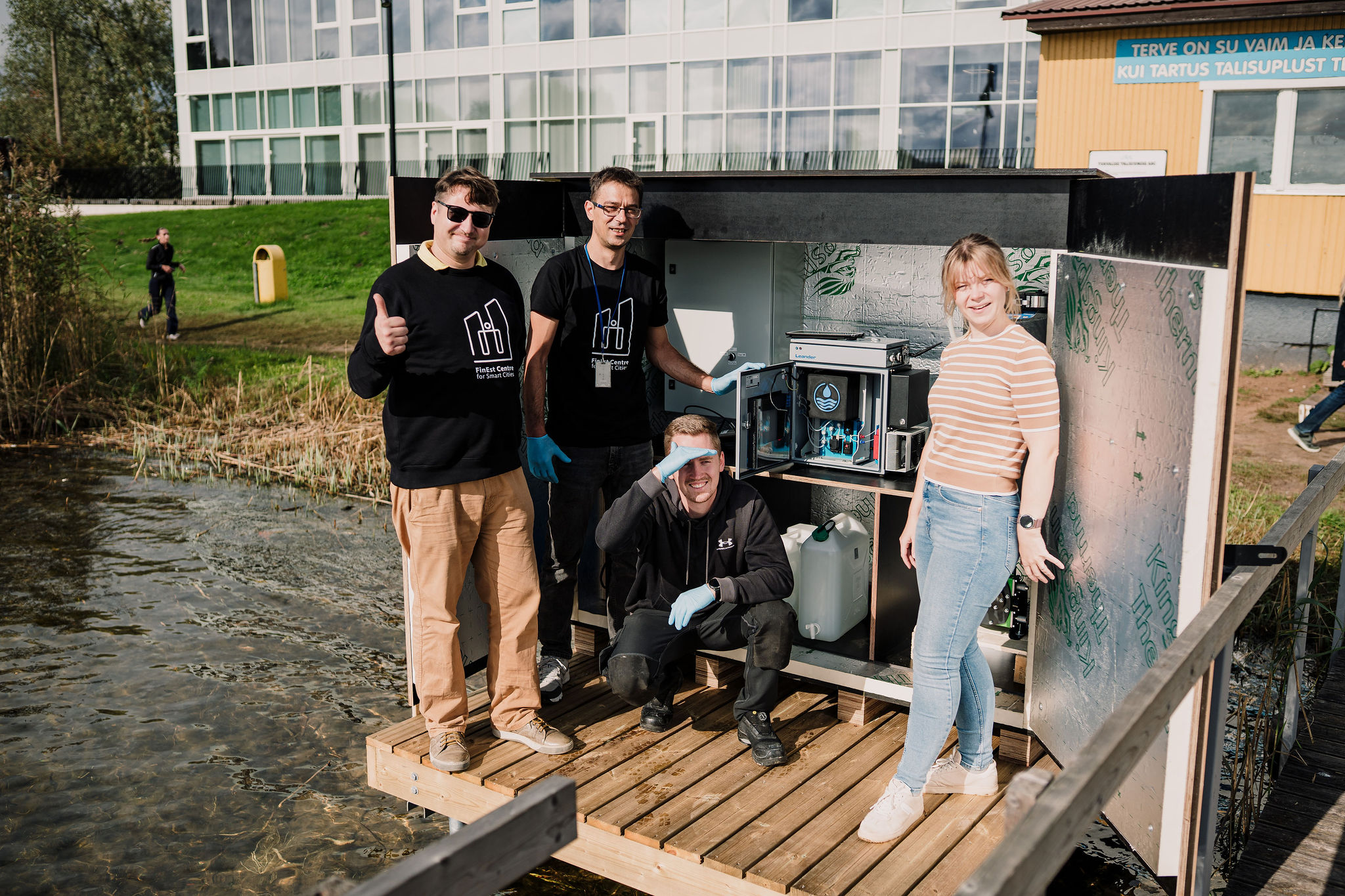
The FinEst Twins Smart City Center of Excellence will invest up to 15 million euros to implement 10 large scale pilots to face the urban challenges in the fields of mobility, energy, built environment, data and governance. This idea competition is based on the challenges mapped with local governments in Estonia. Each idea has to address at least one of the challenges via research and innovation activities and direct involvement of cities. The Smart City Challenge is in process and we received 71 ideas for the deadline on November 6. 12 best proposals have been selected to the finals.
Estonian towns and urban areas for whom this is the top challenge:
Anija, Elva, Haapsalu, Harku, Keila, Lääne-Harju, Maardu, Pärnu, Paide, Rae, Rakvere, Saaremaa, Saue, Tallinn, Valga, Viimsi, Viljandi, Viru-Nigula, Võru
- How to develop a network of roads and streets, so that it encourages mobility by walking, using different two, three and four wheel bicycles, as well as micromobility devices (incl. with electric motors); public transport (bus, train, etc.) and in the future also with self-driving vehicles. It is important to increase the share of sustainable modes of mobility and allow people to have healthy and safe modes of mobility.
- What is a network of roads and streets like that forms a joint part of the entire remaining public space, where there are attractive connecting stations and convenient access ways to shopping centres, also for pedestrians that allow inhabitants to reach the required destination in less than 15 minutes, without using their own car etc.
- What is the transport management system that takes into consideration the needs of inhabitants that live outside the city, but commute on a daily basis to the city to work or go to school.
- How to manage traffic operationally and flexibly, as well as increase road capacity, while at the same time calm the traffic and increase safety.
Estonian towns and urban areas for whom this is the top challenge:
Anija, Elva, Haapsalu, Harku, Kohtla-Järve, Lääne-Harju, Paide, Põltsamaa, Rae, Rakvere, Saue,
Tallinn, Tartu, Viljandi, Viru-Nigula, Vormsi
- It is difficult especially for children, to come to the centre, from the outskirts of the municipality. The transport within rural municipalities, including connections to small islands, is inadequate. There is not sufficient people to create a profitable bus traffic with sufficient frequency. What possibilities are there for creating a transport solution, based on demand based public transport or on transport sharing services (social transport, school transport, transport to work for larger companies etc.), thereby also taking into consideration the needs of inhabitants with special needs.
- The problem facing cities is daily commuting – how to create an integrated and with sufficient frequency public transport connections, as well as a convenient compatibility between cars and public transport, on the outskirts of cities. How to ensure a public transport that functions comfortably and at relevant times, according to the needs of different age groups (for work, school, to the centre for using services: store, medical care, hairdresser etc.).
- Companies are in succession closing long distance bus routes, due to free public transport and a shortage of passengers, wherefore municipal governments need to increasingly organize transport within the rural municipality, as well as county transportation and find opportunities for ensuring a sufficient frequency of routes and establish new routes.
- The municipal government increasingly needs to contribute into organizing social transport, due to the ageing of the population and the chronic shortage of family doctors (due to the distancing and centralization of primary health care services).
Estonian towns and urban areas for whom this is the top challenge:
Anija, Elva, Haapsalu, Maardu, Paide, Põltsamaa, Rae, Rakvere, Saue, Tallinn, Tartu, Valga,
Viljandi, Viru-Nigula, Võru
- There is no unified public transport system for cities and the county, not to mention the national one. Ticket systems are also different. It would be important to have combined planning of different mobility means: bus, train, bicycle, car, micromobility devices etc.
- The possibility of working in public transport is an important advantage over driving private cars. How to create as comfortable as possible conditions for this (a desk for supporting a computer, high speed and stable Internet connection, possibility for privacy – working quietly or making calls, without disturbing others).
- What studies and data analysis must be performed, so that county and regional public transport can be brought into conformity with actual mobility needs.
- It is important to even allow for working in larger cities, up to 100 km away, such that it would be time and energy efficient, as well as comfortable.
- What is the mobility of goods and location of logistics centres that takes into consideration the production and industrial needs, of smaller settlements.
Estonian towns and urban areas for whom this is the top challenge:
Maardu, Paide, Rakvere, Tallinn, Valga, Viimsi, Viru-Nigula, Võru
- How to smartly create structural plans that encompass many detailed plans, to ensure a more unified detailed planning and utilisation of resources, as well as a better urban space that creates prerequisites for sustainable construction and using sustainable energy carriers. How to effectively include the inhabitants?
- The development of blue-green infrastructure in smart cities – what are the environment friendly and smart (rain)water systems like, smart spatial planning solutions that improve the quality of life and assist in improving the environmental condition (e.g. improve management of rainstorms, storms, floods, mitigate the effect of a thermal island etc.)?
- How to take into use the possibilities of geoinformation applications for managing the infrastructure objects, managed by the city (for example street lighting, snow removal, landscaping etc.), as well as spatial analysis (public transport, waste management etc.).
- What opportunities are offered, by using remote sensing and positioning in urban planning (application of innovative solutions from the field of space, in urban space planning).
- How to take into consideration in planning that a person can perform the activities required, for his/her life within the vicinity of the home, ideally on foot, by bike or public transport. How to comfortably organise the mobility of people living in the suburbs, to institutions in the city centre (e.g. kindergartens and schools). How to ensure access to attractive sites, using cycle and pedestrian tracks.. What to do with existing large shopping centres that do not allow for being reached on foot? How to plan the space surrounding centres as compact and pedestrian friendly?
- How to smartly use sensors to collect data, in a way that maximumly improves the well-being of the citizen, so that based on measurement results, it would be possible to conduct simulations and projects that improve the quality of life. The creation of future simulations based on data to predict trends and model people's needs (for example kindergarten places).
- The indicators of water, heat, electricity consumption and production of buildings should be visible in real time, to efficiently plan and forecast energy production, identify high consumption buildings and share consumption, in order to avoid a surge in growth.
- How to further integrate contemporary technologies into urban planning (for example incorporating a model design centred process (BIM), that would allow for a unified processing, during the entire life cycle of the project, as well as information capacity for creating models of landscape, planning, surface and existing buildings). How would such developments also allow for improving the compatibility of possible infrastructure project models (InfraBIM) and use of local urban models (CIM). How is it possible to determine, based on data, the profitability of projects for the rural municipality? A new developer with 3 000 new residents – predict through data analysis the costs and benefits for the rural municipality, as an example.
Estonian towns and urban areas for whom this is the top challenge:
Anija, Jõgeva, Kohtla-Järve, Jääne-Harju, Maardu, Narva, Paide, Põltsamaa, Rakvere,
Saaremaa, Saue, Sillamäe, Tallinn, Tartu, Valga, Viljandi, Viru-Nigula, Võru
- The biggest challenge is the increasing of energy efficiency of buildings – in apartment buildings, as well as in buildings managed by the municipality and in small houses. It is necessary to construct new buildings with low energy consumption and reconstruct existing buildings. How to solve the entire whole economically – light, ventilation, cooling, heat.
- The profitability of offered energy solutions is not easily discernible. There is a lack of knowledge in which buildings it is reasonable to perform projects and the demolition of which would be more appropriate, as they would be depreciated before the solutions have paid off. There is a lack of a unified collection of knowledge, based on which municipalities can make decisions.
- The usable solutions should also be diverse from an architectural aspect. How to ensure the preservation of local peculiarities and traditional architectural heritage, when construction volumes are increasing and in the context of development needs, of the contemporary urban space?
- Investments into buildings of areas of heritage protection are difficult to make – resource intensive, demanding conditions and knowledge of possible usable solutions are fragmented, difficult to find.
- How to efficiently switch from local cooling devices of a building, to environment friendly remote cooling.
- The efficiency and reasonability of district heating in smaller municipalities is low, what could be the solution, the alternative?
- With what to motivate inhabitants to create energy cooperatives that would assist in speeding the taking into use of alternative methods of energy production.
- The withstandability to emergencies of buildings (the supply of heat into the building for example functions, but the internal circulation within the building does not work, during a power failure).
- How to solve the real time availability of information on resource consumption (electricity, heat, CO2, noise etc.), of public buildings. The analysis of these data would be necessary, possibility for simulation that would allow the operational management of the buildings.
Estonian towns and urban areas for whom this is the top challenge:
Elva, Haapsalu, Jõgeva, Keila, Lääneranna, Maardu, Paide, Põltsamaa, Rakvere, Saaremaa,
Saue, Sillamäe, Tallinn, Viru-Nigula, Vormsi, Võru
The availability of electricity to industrial areas is critical. The population of most rural municipalities is decreasing, partially due to a shortage of places for work. How to ensure good conditions for industry, both from the point of view of energy supply and freight transport (railway connection). What would be a sensible development model (currently energy producers do not invest because of a lack of consumers, while industry does not come, because of a lack of conditions).
Estonian towns and urban areas for whom this is the top challenge:
Keila, Kohtla-Järve, Lääne-Harju, Maardu, Paide, Rae, Rakvere, Saaremaa, Tartu, Viljandi, Viru-
Nigula
- The production of electricity and heat based on non-renewable energy sources is problematic. Thermal energy is the energy type with the largest volume, in terms of consumption, but currently still natural gas and peat are partly used for the production of district heating. How to ford local renewable energy production and consumption.
- What are the possibilities for switching the production of district heating to renewable energy sources, to exploit low temperature possibilities in district heating. How to detect and realize projects based on contemporary solutions (production of electricity from waste water, underground or water body based solutions of heat pumps, combined with solar panels)? How to link these projects, with urban architecture and planning (for example constructing city greenhouses, in areas of heat pumps).
Estonian towns and urban areas for whom this is the top challenge:
Elva, Harku, Maardu, Paide, Põltsamaa, Rakvere, Saue, Tallinn, Tartu, Viimsi, Võru
- The need and extent for data collection has not been precisely determined, i.e. which data and what for, needs to be collected. Certain data, at the same time is collected and their volume is constantly increasing.
- The technical capacities and competences for data processing, analyzing and using for management decisions, are currently low. How to improve the general architecture of the city information system (incl. compatibility between local and national registers) and in the longer term, also move toward the direction of a so called functioning of a smart city that would better allow for an analysis of the situation of Estonia, through data of cities.
- An increasing contribution to IT security (ISKE) and data protection, is required in the contemporary information society. The navigation currently in data protection, GDPR, cyber security regulations, is difficult for local governments.
- The data currently available from Statistics Estonia, for example, are not based on regions nor often in real time.
- The data from different databases are not compatible with other databases. Many need based own systems have been created that are centred on a single local government. What should the software be like that is capable of making data from different databases, to communicate with each other? How to create data bridges with neighbouring municipalities, including those of neighbouring countries, to integrate data based management, cooperation and services.
- There is a lack of digital real time urban space monitoring or how to make management of city assets smart, systematic: traffic load on the streets, free parking places, CO2 and noise level on the streets, air quality, real time consumption and monitoring of resources of public buildings; electricity, heat etc., monitoring of waste management.
Estonian towns and urban areas for whom this is the top challenge:
Anija, Maardu, Paide, Põltsamaa, Rakvere, Saue, Tallinn, Tartu, Viimsi, Viljandi, Võru
Municipalities have quite a bit of databases, but they are not used or displayed. Private companies desire and can develop smart, necessary and useful solutions based on open data. How to give data to citizens, organizations and private companies, for free use and the creation of new services, while at the same time ensuring their legitimate and secure management.
Estonian towns and urban areas for whom this is the top challenge:
Maardu, Paide, Rakvere, Saue, Tartu, Viimsi, Viljandi, Viru-Nigula, Võru
- Communication with inhabitants is often slow and inefficient. Inhabitants continuously have an increasingly difficult time to manage their daily lives and obtaining information on services important to them, due to continuously increasing volumes of information. What would be the correct channels of communication that would take into consideration the capabilities and interests of different age groups.
- How to increase the quantity and quality of e-services, how to propagate their use, among the population? The population, in greater parts of Estonia, in cities is decreasing. It is required to find solutions, to ensure the quality of services.
- The document management system does not allow for monitoring the procedures of applications etc. The creation of such capacities would significantly increase efficiency, transparency and quality.
- Emotional ageing and illness are among one of the biggest problems facing older people in Estonia. Social welfare needs to be upgraded and improved. How to develop nursing homes, organize communication, so that people would not hold on to their real estate, but would have a desire to go to a nursing home, where all living conditions are better (health, social life). Find ways for optimizing the work of support personnel, in conditions of decreasing personnel, in caring for ageing people.